
Is the environment of Hong Kong IVF hospitals comfortable? Real experience and criteria for judgment

The overall environment of Hong Kong IVF hospitals is relatively high, but different hospitals vary in waiting areas, consultation rooms, operating rooms, and embryology labs. Environmental comfort should be assessed based on hardware, hygiene, privacy, and process efficiency, serving as a reference for selection rather than a core decision factor.
Opening: Real consultation scenario
Consultation scenario: A 38-year-old woman living in Shenzhen, with AMH 1.2 ng/mL, had one egg retrieval but the result was not ideal. She asked on the phone: “I heard the environment of Hong Kong IVF hospitals is very good. Is that true? Does a good environment help with success rates? Or is it just a gimmick?”
The true meaning of environmental comfort
The question “Is the environment of Hong Kong IVF hospitals comfortable?” usually implies two things: whether the hardware facilities are adequate, and whether the overall experience is relaxing. From actual visits, fertility centers in Hong Kong generally score high in terms of environment, but “comfort” is a multi-dimensional concept that needs to be broken down.
Environmental comfort does not necessarily mean a higher success rate, but it can affect the patient’s psychological state, treatment compliance, and stress levels during the process. The following analyzes the current environmental status of Hong Kong IVF hospitals from five core dimensions.
Hardware facilities and spatial design
Private hospitals and independent fertility centers in Hong Kong generally emphasize privacy and logical flow in spatial design. Waiting areas often use semi-enclosed or individual seating layouts to reduce visual interference between patients. Consultation rooms are mainly private, and examination rooms are separate from consultation rooms, preventing patients from moving back and forth between different functional areas.
- Waiting area: Private facilities have larger seat spacing, equipped with charging ports, water dispensers, magazine racks, and some offer private waiting rooms.
- Consultation room: Consultation rooms are about 10-15㎡, equipped with an ultrasound bed, sink, doctor’s workstation, and overall warm color tones.
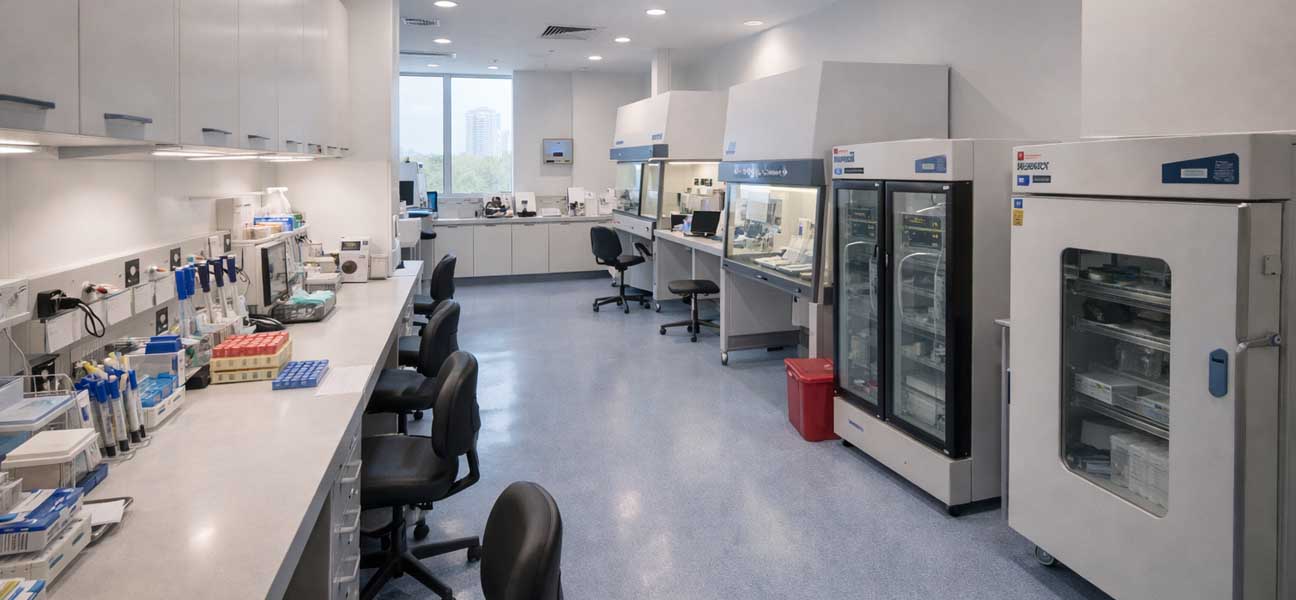
- Operating room: Egg retrieval and embryo transfer operating rooms meet laminar flow purification standards, with constant temperature and humidity, and walls made of antibacterial materials.
- Embryology lab: This is the core area, usually inaccessible to patients, but the lab’s air quality, temperature control, and noise control directly determine the quality of embryo culture. Private centers in Hong Kong often equip their labs with independent fresh air systems and continuous monitoring equipment.
Environmental differences among different types of hospitals
IVF service providers in Hong Kong can be divided into three categories, with significant differences in environmental levels.
| Hospital type | Representative institution | Environmental features | Suitable for |
|---|---|---|---|
| Large private hospital | Hong Kong Sanatorium Hospital, Union Hospital, Gleneagles Hospital Hong Kong | Modern overall decoration, spacious, hotel-style management, high comfort in waiting areas, internationally certified labs | Those with high environmental requirements, sufficient budget, and seeking one-stop service |
| Independent fertility center | Hong Kong Reproductive Medicine Centre, Primus Medical etc. | Designed specifically for IVF, efficient flow, emphasis on privacy, faster lab equipment updates, but smaller scale than general hospitals | Those who value lab quality and consultation efficiency, and have high privacy requirements |
| Public hospital | Queen Mary Hospital, Prince of Wales Hospital | Practical environment, relatively crowded waiting areas, older decoration, but standardized medical procedures, labs meet standards | Those with limited budget, not concerned about environment, and value the technical expertise of public hospitals |
Why environmental comfort affects the consultation experience
Assisted reproductive treatment cycles usually last 4-8 weeks, requiring multiple hospital visits for monitoring, egg retrieval, and embryo transfer. If the environment is noisy, cramped, or lacks privacy, patients’ anxiety levels can significantly increase. Elevated cortisol levels may disrupt the endocrine axis, indirectly affecting follicle development and endometrial receptivity.
From a doctor’s perspective, the role of the environment is more about “reducing interference” than “directly improving success rates.” A doctor who has worked at the Hong Kong Sanatorium Hospital Fertility Centre for over 12 years once mentioned: “A good environment makes patients more willing to attend follow-up appointments on time, reducing dropout rates, which is important for cycle management.”
Details most easily overlooked
Most people focus on whether the waiting area looks nice or the sofas are comfortable, but the following details have a greater impact on the treatment experience and are often overlooked.
- Disinfectant odor: Some facilities use strong disinfectants with a pungent smell that may cause nausea or headaches. Sensitive waiting areas and consultation rooms should use low-irritation disinfection protocols.
- Toilet cleaning frequency: Patients need to urinate frequently before and after egg retrieval; toilet hygiene directly affects comfort. It is recommended to check the cleaning records during a site visit.
- Noise control: Some Hong Kong hospitals are located in commercial areas or near main roads, where outside noise may affect rest. The soundproofing of operating rooms and wards should be confirmed.
- Temperature and ventilation: Hong Kong summers are hot, and indoor air conditioning temperatures are often low. Some patients report feeling too cold while waiting in the waiting area; it is advisable to bring a jacket.
- Parking and transport connections: For cross-border or cross-district patients, whether the hospital offers parking, is near an MTR station, or has direct bus services directly affects the energy spent on each visit.
Common pitfalls
Based on observations from a consultant with 10 years of experience, the following three misconceptions are most common.
Misconception 1: Judging environmental quality by the newness of decoration
Some newly renovated facilities use a lot of mirrors, metal, and dark stone, creating a modern visual effect but potentially causing light pollution and a cold feeling. In contrast, some centers that have been operating for years may not have new decoration but have a logical layout, thorough cleaning, and appropriate temperature and humidity, resulting in a better actual experience.
Misconception 2: Ignoring the lab environment
The lab is where embryos are cultured; its air quality, temperature stability, and vibration control directly determine embryo quality. However, patients usually cannot see inside the lab. It is recommended to ask directly during consultation: Is the lab certified by the UK HFEA or CAP? Is it equipped with a 24-hour monitoring system? Does the air quality meet ISO Class 5 standards?
Misconception 3: Making the environment the primary selection criterion
Environmental comfort should be a “bonus point” rather than a “core decision factor.” The doctor’s clinical experience, the lab’s quality control system, and the match between the medication protocol and the patient’s condition have a much greater impact on success rates than whether the waiting area looks good. A hospital with a good environment but insufficient doctor experience or lab standards may have a lower success rate than a center with an average environment but solid technology.
Environmental experience during the actual consultation process
Taking a complete Hong Kong IVF cycle as an example, the environmental experience runs through the following stages:
| Stage | Environment-related experience points | What to pay attention to |
|---|---|---|
| Initial consultation | Waiting time in the waiting area, privacy of the consultation room | Is waiting time over 30 minutes common? Is the consultation room soundproof? |
| Cycle monitoring | Queue process in the ultrasound room, changing space, toilet convenience | Do you need to remove shoes for monitoring? Is there a private changing room? |
| Egg retrieval surgery | Operating room temperature, quietness of the recovery area, comfort of the post-operative observation bed | Are blankets and drinking water provided in the recovery area? How fast is the nurse response? |
| Embryo transfer | Atmosphere of the transfer room, whether there is a screen showing real-time images, post-operative rest time | Is soothing music played in the transfer room? How long can you lie down after the procedure? |
Frequently asked questions
The following questions are repeatedly asked during consultations, and the answers are summarized below.
- Q: How big is the environmental gap between private and public hospitals in Hong Kong? The gap is mainly in waiting area space, decoration standards, and privacy protection. Private hospitals have larger waiting areas and more comfortable seats, while public hospitals are more crowded. However, the cleanliness standards of operating rooms and labs must both meet the requirements of the Hong Kong Department of Health, so the gap is small.
- Q: Are hospitals with better environments more expensive? Fees are mainly composed of doctor fees, lab operation fees, and medication costs. The environment has a relatively low impact on the total cost. Private hospitals generally charge more than public hospitals, but within the same tier, environmental differences have a limited effect on price.
- Q: Is the environmental experience worth it for IVF from Shenzhen to Hong Kong? If you choose a private facility, the environmental experience is generally better than public hospitals in mainland China, but the time cost of crossing the border and commuting should be considered. It is recommended to first schedule a site visit to experience the waiting area, consultation room, and toilet environment before deciding.
- Q: Does a comfortable environment mean fewer complications? There is no direct causal relationship between environment and complications. The incidence of complications mainly depends on the patient’s age, ovarian function, comorbidities, and the doctor’s operating standards, not on whether the waiting area is comfortable.
Practitioner’s observation: A 10-year consultant’s perspective
Having worked in the assisted reproduction industry for over 10 years and dealt with more than 1,200 cross-border treatment families, here are two observations regarding the environment for your reference.
First, the environment has a significant psychological calming effect on first-time patients. Especially for those who have experienced failure or are completely unfamiliar with the IVF process, entering a quiet, clean, and private space can significantly reduce anxiety levels. This psychological effect positively helps with compliance in subsequent treatment.
Second, the environment cannot replace medical strength. There was a 43-year-old patient who liked a particular hospital’s environment so much that she did two cycles there consecutively, but neither resulted in embryos. She later transferred to another center with an average environment but strict lab quality control, and obtained one transferable embryo through PGT-A screening. The environment is a bonus, but the doctor’s protocol and lab technology are the core.
How to judge whether a hospital’s environment suits you
It is recommended to evaluate using the following steps:
- Online screening: Check the hospital’s website or Google Street View to understand the location, surrounding transportation, and building appearance.
- Site visit (key step): Schedule a visit on a non-treatment day, focusing on the waiting area, toilets, consultation rooms, and operating room floor corridors. Pay attention to smells, noise, temperature, and cleanliness.
- Focus on invisible environment: Ask about the lab’s air quality standards, whether there is independent power supply and backup generators, and whether there is 24-hour monitoring.
- Compare 2-3 facilities: Don’t just look at one; horizontal comparison makes it easier to spot differences. Record the pros and cons of each in a table.
- Consider your own sensitivity: If you are very sensitive to the environment and easily distracted by noise or smells, then the environment weight can be appropriately increased. If you focus more on medical outcomes, the environment weight can be reduced.
Special situation handling
The following situations require special attention to environmental issues:
- Claustrophobia or anxiety disorder: Prioritize institutions with windows in consultation and operating rooms, and open waiting areas.
- Allergy to chemical odors: Inform the hospital in advance, request low-allergen disinfectants, and choose well-ventilated consultation rooms.
- Need for wheelchair or mobility issues: Confirm whether the hospital has accessible ramps, elevator width, and toilet handrails.
- Bringing children to appointments: Some facilities offer children’s waiting areas or toy corners. If children are unsupervised, confirm in advance whether they are allowed into the consultation room.
Summary answer
Back to the original question: Is the environment of Hong Kong IVF hospitals comfortable? Overall, the environmental comfort of private hospitals and independent fertility centers in Hong Kong is at a high level, with generally standardized spatial design, privacy protection, and cleaning maintenance. Public hospitals have a relatively basic but adequate environment. Environmental comfort can affect the consultation experience and psychological state, but it should not be the sole or primary criterion for choosing a hospital. It is recommended to consider the environment as one of the reference factors, combined with the doctor’s experience, lab quality control, personal budget, and commuting convenience for a comprehensive decision.
Hong Kong IVF Hospital environment Assisted reproduction Embryology lab Patient experience Private hospital Cross-border medical care
0 comments