
What Medical Tests Are Needed for IVF in Hong Kong? Female & Male Checklist and Timeline

Medical tests required before IVF in Hong Kong include female ovarian reserve assessment (AMH, FSH, antral follicle count), male semen analysis, infectious disease screening for both partners, chromosome karyotyping, and thalassemia screening. This article details each test, optimal timing, report validity, and key considerations to help you systematically understand the pre-IVF preparation process in Hong Kong.
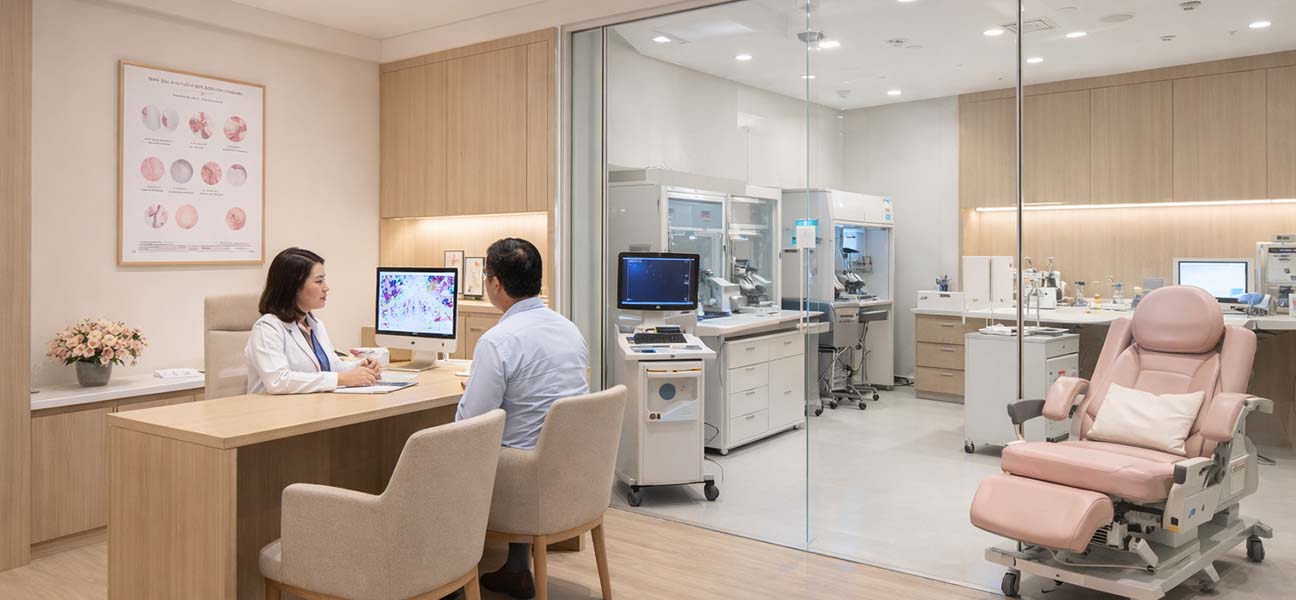
Opening: Real Clinic Scenario
Clinic Scenario: A 38-year-old woman walks into the consultation room holding several test reports. She had AMH and hormone tests done at a hospital in Shenzhen, but she doesn't know which additional tests are needed for IVF in Hong Kong, nor which reports are accepted in Hong Kong and which need to be redone. This is a very typical situation in the clinic – many people think IVF tests are just blood draws and ultrasounds, but it's actually much more.
Medical Tests for IVF in Hong Kong: Core Answers
Medical tests before IVF in Hong Kong are divided into three main sections: female tests, male tests, and tests for both partners. Core female tests include Anti-Müllerian Hormone (AMH), Day 2–4 hormone panel, transvaginal ultrasound for antral follicle count (AFC), thyroid function, and infectious disease screening; core male tests include routine semen analysis, sperm morphology assessment, and infectious disease screening; both partners need blood type, chromosome karyotyping, and thalassemia screening. Some tests need to be done at specific times during the menstrual cycle, and a 3–5 day abstinence period is required before semen analysis. It is recommended to start testing 1–3 months in advance to ensure all reports are within their validity period.
Actual Testing Process and Checklist
The following process is compiled based on the standard requirements of major fertility centers in Hong Kong. There may be slight differences between centers, but the core tests are highly consistent.
Female Test Checklist
| Test Item | Purpose | Optimal Timing | Report Validity |
|---|---|---|---|
| AMH (Anti-Müllerian Hormone) | Assess ovarian reserve | Any day of menstrual cycle | 6–12 months |
| Hormone Panel (FSH, LH, E2, P, T, PRL) | Evaluate endocrine status and ovarian function | Day 2–4 of menstrual cycle | 3–6 months |
| Transvaginal Ultrasound (Antral Follicle Count AFC) | Directly observe follicle count and uterine condition | Day 2–5 of menstrual cycle | 3 months |
| Thyroid Function (TSH, FT3, FT4) | Rule out thyroid dysfunction affecting pregnancy | Any time (fasting recommended) | 6 months |
| Infectious Disease Screening (Hepatitis B, Hepatitis C, HIV, Syphilis) | Ensure maternal and infant safety and lab biosafety | Any time | 6 months |
| Chromosome Karyotyping | Rule out chromosomal structural abnormalities | Any time | Lifetime validity |
| Thalassemia Screening (CBC + Hemoglobin Electrophoresis) | High prevalence in Hong Kong, screen for genetic risk | Any time | Lifetime validity |
| Blood Type and RH Factor | Blood preparation and assessment of newborn hemolysis risk | Any time | Lifetime validity |
| TORCH Panel | Screen for toxoplasmosis, rubella, etc. | Any time | 6–12 months |
| Coagulation Profile | Assess bleeding and thrombosis risk | Any time | 6 months |
Male Test Checklist
| Test Item | Purpose | Notes | Report Validity |
|---|---|---|---|
| Routine Semen Analysis | Assess sperm concentration, motility, morphology | Abstain for 3–5 days | 3–6 months |
| Sperm Morphology Assessment | Evaluate percentage of normal sperm forms | Done simultaneously with routine semen analysis | 3–6 months |
| Sperm DNA Fragmentation Index (DFI) | Assess sperm DNA integrity | Required by some centers, abstain for 3–5 days | 6 months |
| Infectious Disease Screening (Hepatitis B, Hepatitis C, HIV, Syphilis) | Ensure lab safety and partner protection | Any time | 6 months |
| Chromosome Karyotyping | Rule out chromosomal structural abnormalities | Any time | Lifetime validity |
| Thalassemia Screening | Screen for genetic risk | Any time | Lifetime validity |
| Blood Type and RH Factor | Blood preparation and risk assessment | Any time | Lifetime validity |
Test Timeline: What to Do and When
A well-planned testing timeline can help avoid multiple hospital visits and ensure all reports are valid. Here is a reference timeline:
- 3–4 months before plan: Complete lifetime-valid tests like chromosome karyotyping, thalassemia screening, and blood type. These tests take longer to get results (chromosome analysis usually takes 10–14 working days), so do them first.
- 2–3 months before plan: Female: complete AMH, thyroid function, coagulation profile, TORCH panel. Male: complete semen analysis and sperm morphology assessment. If semen results are abnormal, there is still time for a repeat test or intervention.
- 1–2 months before plan: Female: complete hormone panel and transvaginal ultrasound (AFC) on day 2–4 of the menstrual cycle. Both partners: complete infectious disease screening.
- 2–4 weeks before plan: Organize all reports, confirm nothing is missing, make copies or scans. Some Hong Kong fertility centers require original documents for verification.
Timing Key Points
✔ Chromosome analysis + Thalassemia screening: Do first (long wait for results)
✔ Hormone panel + Transvaginal ultrasound: Must be done on day 2–5 of menstrual cycle
✔ Semen analysis: Abstain for 3–5 days, consider doing it twice for an average
✔ Infectious disease screening: Do last (valid for 6 months, doing it too early may cause it to expire)
Interpreting Key Test Results: How Doctors View This Data
As a reproductive specialist, the first things I look at on a test report are the following core indicators, which directly determine the subsequent plan:
AMH: The "Hard Indicator" of Ovarian Reserve
AMH is one of the most stable indicators for assessing ovarian reserve and is not affected by the menstrual cycle. AMH > 1.2 ng/mL usually indicates normal ovarian reserve; 0.5–1.2 ng/mL indicates diminished reserve; < 0.5 ng/mL indicates severely diminished reserve. AMH levels directly influence the medication dosage and expected number of eggs retrieved in the stimulation protocol.
FSH + AFC: Combined Assessment of Ovarian Response
If FSH level on day 2–4 of the menstrual cycle is > 10 IU/L, it may indicate reduced ovarian response. However, FSH alone has limitations and should be combined with AFC (antral follicle count) for a comprehensive assessment. A total AFC < 5–7 usually suggests reduced ovarian reserve. Combining both is more accurate than either alone.
Semen Analysis: More Than Just Concentration
In male semen analysis, concentration ≥ 15×10⁶/mL, motility (PR+NP) ≥ 40%, and normal morphology ≥ 4% (strict criteria) are the lower reference limits. However, note that single results can vary significantly. If the first result is abnormal, repeat the test after 3–5 days of abstinence. Sperm DNA fragmentation index (DFI) > 30% may affect embryo development and pregnancy outcomes; this test is now routine in some Hong Kong centers.
Different Age Groups, Different Testing Priorities
Age is one of the most important variables affecting IVF plans. Testing priorities and evaluation logic differ significantly by age group:
| Age Group | Core Focus | Recommended Additional Tests | Plan Tendency |
|---|---|---|---|
| Under 35 | Basic fertility assessment | Standard tests only, no special additions | Standard stimulation protocol |
| 35–38 | Ovarian reserve + embryo chromosome risk | AMH, chromosome karyotyping, PGT counseling | Adjust medication dose based on AMH |
| 38–40 | Number of eggs retrieved + embryo euploidy rate | AMH, AFC, DFI (male), PGT-A | Consider cumulative cycles or PGT strategy |
| Over 40 | Ovarian response + pregnancy safety | Comprehensive cardiac function, coagulation, chromosome, PGT-A | Personalized mild stimulation or luteal phase stimulation |
For women over 38, in addition to standard tests, hysteroscopy and endometrial gene testing (ERA) may also be considered, especially in cases of previous implantation failure.
Most Easily Overlooked Details
Based on clinical experience, these details are most often overlooked by patients but can directly affect the accuracy and progress of test results:
- Abstinence period before semen analysis: Too long (over 7 days) or too short (less than 2 days) can affect sperm concentration and motility. Strictly controlling it to 3–5 days is most accurate.
- Timing window for hormone tests: FSH, LH, and E2 must be checked on day 2–4 of the menstrual cycle. Testing FSH at other times significantly reduces its reference value. If cycles are irregular, a doctor should determine if medication is needed to induce withdrawal bleeding before testing.
- Thalassemia screening is mandatory in Hong Kong: The carrier rate for thalassemia is relatively high in Hong Kong (about 8%), and all fertility centers require both partners to complete this screening. Some hospitals in mainland China do not routinely test for thalassemia, so it is easily overlooked.
- Chromosome analysis requires advance booking: Not all hospitals perform chromosome karyotyping, and results take 10–14 working days, possibly longer during holidays. Confirm the lab schedule in advance.
- Some Hong Kong centers do not accept mainland reports: For infectious disease screening, hormone tests, etc., some Hong Kong fertility centers require them to be done at their own or a designated lab. Check with the center in advance about which reports are accepted.
Most Common Pitfalls
Here are the most common "pitfalls" patients encounter in practice, some of which can directly lead to delays or extra costs:
- Bringing expired reports to the appointment. Infectious disease screening and hormone tests are usually valid for 6 months, semen analysis for 3–6 months. If reports are expired, they must be redone, costing both time and money.
- Doing hormone tests outside the menstrual cycle window. This is one of the most common issues. If you can't test on day 2–4, you have to wait for the next cycle, delaying the entire timeline.
- Incorrect abstinence period before semen analysis. Abstaining for less than 3 days or more than 7 days will skew the results. If results are abnormal, a repeat sample is needed, delaying the cycle.
- Missing thalassemia screening. Hospitals in non-high-prevalence areas in mainland China may not proactively order thalassemia screening, and patients may not be aware. Arriving in Hong Kong and being told it's needed means extra time to arrange it.
- Underestimating the wait time for chromosome results. Chromosome karyotyping requires cell culture and banding analysis, usually taking about 2 weeks. It can take longer during holidays or if the lab has a backlog.
How Doctors View Test Results: Decision Logic
As a reproductive specialist, when I see a complete set of test reports, my decision logic usually follows this order:
- Step 1: Assess ovarian reserve. Look at AMH + AFC + FSH to comprehensively evaluate ovarian response and determine the stimulation protocol and starting medication dose.
- Step 2: Rule out genetic risks. Look at chromosome karyotyping and thalassemia screening results to determine if genetic counseling or PGT is needed.
- Step 3: Evaluate the endocrine environment. Look at thyroid function, prolactin, androgens, etc., to rule out endocrine abnormalities affecting pregnancy.
- Step 4: Check for infections. Look at infectious disease screening, TORCH, etc., to ensure maternal and infant safety and lab safety.
- Step 5: Integrate male factors. Combine semen analysis results to assess whether ICSI or donor sperm is needed.
If all test results are within normal range, you can proceed directly to the IVF cycle. If there are abnormal indicators, they need to be addressed or the plan adjusted. For example, elevated TSH requires medication to bring it below 2.5 mIU/L; severely abnormal semen may require adding ICSI.
Frequently Asked Questions
Can I still do IVF in Hong Kong if my AMH is low?
Yes. Low AMH doesn't mean you can't do IVF; it means the number of eggs retrieved may be lower, requiring a more personalized stimulation protocol (e.g., mild stimulation, natural cycle, or luteal phase stimulation). In such cases, it's advisable to communicate fully with your doctor beforehand and manage expectations. For those with low AMH, it's also important to focus on FSH and AFC for a comprehensive assessment of ovarian response.
How far in advance should I prepare for IVF in Hong Kong?
From starting tests to officially beginning the cycle, it's generally recommended to allow 2–3 months. If lifetime-valid tests like chromosome analysis and thalassemia screening haven't been done, add another month. If all tests are done intensively, it can be completed in as little as 1.5 months, but this requires the menstrual cycle to align perfectly and all reports to be issued smoothly.
Does Hong Kong accept test reports from mainland China?
Most Hong Kong fertility centers accept reports from mainland tertiary hospitals, but with certain conditions: reports must be within their validity period, have a hospital stamp or doctor's signature, and some tests (like infectious disease screening) may require verification at a designated lab in Hong Kong. Chromosome karyotyping and thalassemia screening are generally well-accepted, but some centers may require hormone tests and semen analysis to be redone. It's best to ask the center directly about their specific acceptance policy when booking.
Can the male partner skip some tests?
No. IVF in Hong Kong requires both partners to complete all core tests; male tests cannot be omitted. Semen analysis is crucial for determining the need for ICSI, and chromosome and thalassemia screening involve genetic risks for offspring. Even if the male has a history of normal fertility, these tests are mandatory.
Handling Special Situations
The following situations require additional tests or adjustments to the standard process:
- History of miscarriage: Add tests for recurrent pregnancy loss (antiphospholipid antibodies, coagulation factors, hysteroscopy, etc.). Chromosome karyotyping is mandatory.
- Advanced maternal age (≥40): Add cardiac function assessment, coagulation profile, blood glucose and blood pressure monitoring, and PGT-A counseling.
- Severe male semen abnormalities: Add sperm DNA fragmentation index (DFI), Y chromosome microdeletion testing, and reproductive hormone tests.
- Family history of genetic disorders: Requires genetic counseling and additional gene testing or carrier screening based on the specific condition.
- Previous IVF failure: Based on the cause of failure, add hysteroscopy, endometrial gene testing (ERA), immunological tests, etc.
Doctor's Advice
Medical tests before IVF in Hong Kong are not a one-time task but a process that requires dynamic management. Here are a few points worth special attention:
- Scan and save electronic copies of all test reports, and bring the originals when you go to Hong Kong.
- If any abnormal indicators are found during testing, do not assume "it's not a big deal." Listen to the professional advice of your reproductive specialist and address issues before starting the cycle if necessary.
- Testing is just the beginning. IVF success depends on multiple factors. Normal test results don't guarantee success, and abnormal results don't mean there is no chance.
- Before choosing a fertility center in Hong Kong, confirm its policy on accepting mainland reports to avoid delays due to test report issues.
—— Clinical Reproductive Medicine Specialist
0 comments