
Overseas Ovarian Stimulation for PCOS: How Can OHSS Be Prevented While Improving Mature Egg Yield?

Overseas ovarian stimulation for PCOS requires coordinated assessment of endocrine and metabolic status, a cautious starting dose, close monitoring, an individualized trigger and an appropriate embryo-transfer schedule. The aim is not to produce the largest possible number of follicles, but to improve synchronized development and mature egg yield while reducing OHSS risk. Hong Kong may be used for regulated assessment and review, while Thailand and Kyrgyzstan should be compared by laboratory capability, monitoring arrangements and continuity of cross-border care.

During ovarian stimulation abroad, patients with polycystic ovary syndrome often face a central contradiction: a large number of follicles but a lower-than-expected proportion of mature eggs.
Both long agonist and antagonist protocols require careful dose adjustment in high responders. Otherwise, the cycle may produce eggs at different stages of maturity and increase the risk of ovarian hyperstimulation syndrome. This guide focuses on three connected stages: stimulation design, trigger timing and coordination with the embryology laboratory.
The First Question Is Not Where to Go, but Why the Previous Cycle Over-Responded
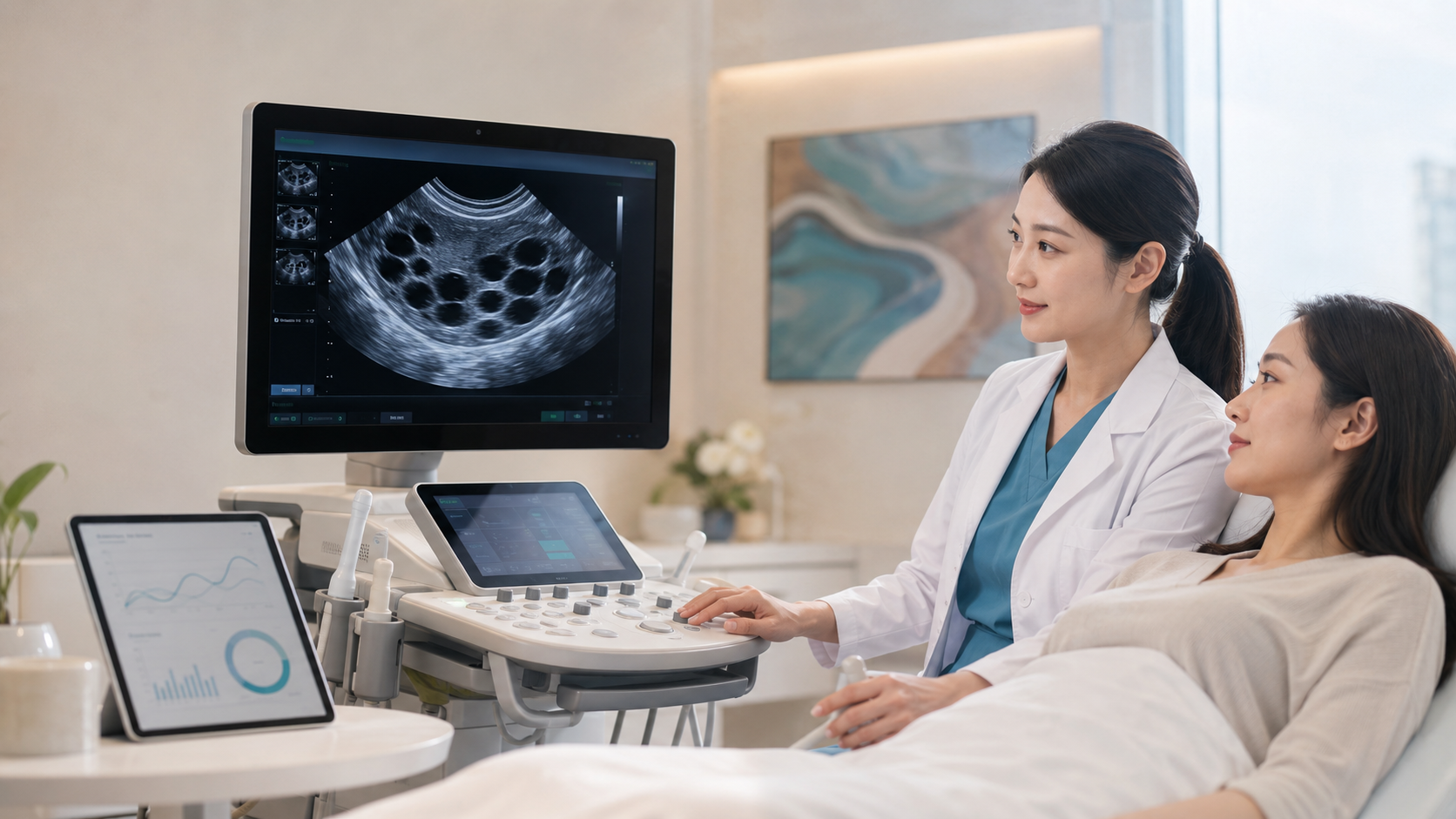
During a consultation, a 32-year-old woman presents her previous IVF records. Her AMH was elevated, her baseline AFC exceeded 30, and numerous follicles developed during stimulation. Although many eggs were retrieved, the mature oocyte rate was disappointing. After retrieval, she experienced persistent bloating, nausea and rapid weight gain, making her concerned that another overseas cycle would cause OHSS.
Instead of immediately recommending a country or a standard protocol, the physician reviews her daily gonadotropin doses, estradiol trend, distribution of follicle sizes, trigger medication and post-retrieval symptoms.
The main problem may not be insufficient medication. It may be an excessive starting dose, delayed adjustment or poor follicular synchronization at the time of trigger.
Before Travel: Build a High-Response Risk Profile
Before going abroad, patients with PCOS should organize their AMH, AFC, LH, FSH, estradiol, glucose, insulin, HbA1c, thyroid results and previous stimulation records.
Obesity, insulin resistance, infrequent menstruation and any history of OHSS should also be disclosed. A high AMH level and numerous follicles may indicate a potentially high egg yield, but they do not guarantee that every retrieved egg will be mature.
The physician should assess metabolic status, follicular synchronization and previous medication response before choosing the starting dose. Metformin is not required for every patient. Its use should depend on metabolic findings, the selected protocol and medical judgment, and it should not be started without supervision.
During Stimulation: Replace Fixed Dosing With Dynamic Adjustment
High responders often benefit from a low starting dose, close monitoring and timely adjustment. Monitoring should not focus only on the leading follicle. It should also assess the number of small and intermediate follicles, the response of both ovaries, the speed of estradiol elevation and emerging physical symptoms.
International evidence-based guidance for PCOS notes that an antagonist protocol offers an important safety advantage: when OHSS risk rises, it permits the use of a GnRH agonist trigger followed by a freeze-all strategy. This does not mean that every patient with PCOS requires an identical protocol, nor does it mean that increasing medication will improve egg quality.
Trigger Day: The Point at Which Maturity and Safety Diverge
Trigger timing should not be determined by a single leading follicle. If a few follicles are already large while many remain small, triggering too early may reduce the mature oocyte rate. Continuing stimulation simply to allow smaller follicles to catch up, however, may increase the risk of OHSS.
For a high-risk patient, the physician may consider a GnRH agonist trigger, reduce or avoid additional hCG, cancel fresh transfer and freeze all suitable embryos.
The American Society for Reproductive Medicine identifies antagonist protocols, agonist triggering and freeze-all strategies as important measures for reducing moderate-to-severe OHSS. Adding hCG may sometimes support maturation or the luteal phase, but it can reintroduce OHSS risk and must therefore be individualized.
Not transferring an embryo in the retrieval cycle does not mean that the cycle has failed. It separates ovarian stimulation from implantation and allows the ovaries and hormone levels to recover before endometrial preparation.
After Retrieval: The Laboratory Cannot Correct Every Synchronization Problem
Egg-related outcomes are not determined by the incubator alone. Oocyte maturity at retrieval, the interval between trigger and collection, semen quality, fertilization method and culture stability all influence subsequent development.
When a previous cycle produced a low mature-oocyte rate, the overseas clinic should report each stage separately:
Total oocytes retrieved;
Metaphase II mature oocytes;
Normally fertilized oocytes;
Cleavage-stage embryos;
Blastocysts obtained.
A report stating only the total number of eggs is not sufficient. The team may also need to review whether the trigger was administered correctly, whether a male-factor issue contributed to poor fertilization, and whether the laboratory is experienced in handling high-volume retrievals.
Coordinating Care Across Hong Kong, Thailand and Kyrgyzstan
Hong Kong can be used for endocrine, metabolic and ultrasound reassessment or for obtaining a second opinion before departure. Patients should select a center licensed by the Hong Kong Council on Human Reproductive Technology. If gametes or embryos may be transported across borders, the licences of both centers, consent documents, transport arrangements and acceptance requirements should be checked in advance.
Thailand may appeal to patients who value convenient travel within Asia, frequent monitoring and established embryology services. In Kyrgyzstan, patients should closely examine the clinic’s experience with high-response cycles, emergency referral arrangements, language support and post-retrieval follow-up.
The decision should not be based only on package price. Patients should ask about monitoring frequency, after-hours contact, the clinic’s OHSS response pathway and whether the laboratory provides stage-by-stage reports.
If a later plan involves a gestational carrier or another third-party reproductive arrangement, that pathway should be assessed separately from ovarian stimulation and embryo culture. Independent legal review is necessary according to the intended parent’s identity, marital status and the latest local regulations.
The objective of stimulation for PCOS is not to produce the greatest possible number of follicles. It is to obtain a sufficient number of mature oocytes within a safe treatment window.
Overseas clinics may offer different medication combinations and scheduling options, but these choices are useful only when the patient’s endocrine and metabolic assessment is sufficiently complete. If you have previously experienced an excessive response or a low mature-oocyte rate, organize your medication records and follicular monitoring data before the next cycle. This allows the overseas physician to determine more quickly whether the protocol, dose adjustment, trigger or embryo-transfer schedule should be changed.
0 comments